Volume IV · The Debate on Animal Exploitation · chapter 1
How Do the Animals Exploited by Humans Live and Die?
Before you read study layer, not part of the original text
Exploited animals, especially those used for food, live in confinement, suffer disease, mutilation, and transport, and are killed in slaughterhouses or by fishing in ways we would never accept for humans; there is no justification for this double standard.
Most animals used for food live locked up in cramped places, far from their mothers, sometimes injured, and are killed very young. If this happened to people, everyone would think it was horrible. Their suffering is just the same.
If a factory treated dogs this way, there would be protests at the gate the next day. The only difference is the species of whoever is inside.
- P1 Animal exploitation causes intense suffering and death to an enormous number of animals.
- P2 Treating humans this way would be considered unacceptable because suffering and dying like that seriously harms the victims.
- P3 Exploited animals are also seriously harmed by it.
- C Therefore, accepting for them what would be unacceptable for humans is an unjustified double standard.
The chapter’s central argument in logical form. If the premises are true, the conclusion follows. To disagree, you have to show which premise is false.
They say “These days animals are raised and slaughtered humanely.”
Answer The chapter describes what is common and legal practice: confinement, mutilation without anesthesia, disease, long transport, and slaughter on a massive scale. And fishing, which kills most of the animals, has almost no rules at all.
More objections and answers in Debunking objections.
Original text Luciano Carlos Cunha · Volume IV, p. 9 of the PDF edition · English translation
1.1. Animal exploitation
Nonhuman animals are exploited and killed by humans every day for a wide variety of purposes. They are used as food, for clothing, as test subjects, for entertainment and leisure, and as workers or tools. The form of exploitation that kills by far the most animals is their use as food. Counting vertebrates alone, it is estimated that at least 2 trillion are killed worldwide every year for consumption. That already means that on average, in a single day, around 5.5 billion vertebrates are killed. To get a sense of how large this number is, we need only recall that there are around 8 billion humans in the world. However, the overwhelming majority of the animals humans exploit are invertebrates1. The following table presents some statistics on the kinds of animals killed in each form of exploitation for consumption.
| Type of exploitation for consumption | Animals killed worldwide per year |
|---|---|
| Mammals and birds | Around 80 billion2. |
| Farmed fish | 3Between 51 and 167 billion. |
| Fish caught in the wild at sea | 4Between 787 billion and 2.3 trillion. |
| Aquatic animals used as feed for farmed fish | Between 462 billion and 1.1 trillion5. |
| Farmed decapod crustaceans | 6Between 255 and 604 billion. |
| Silkworms used in silk production | Between 420 billion and 1 trillion7. |
| Insects killed for consumption | Between 2 and 3.2 trillion8. |
| Cochineal insects used to produce carmine dye | 9Between 4.6 and 21 trillion. |
| Shrimp caught in the wild at sea | 10Around 25 trillion. |
Adding up these numbers suggests that somewhere between 34 and 54 trillion animals are killed every year worldwide. This means that, for consumption alone, between 93 and 147 billion nonhuman animals are killed per day. In other words, for consumption alone, the number of animals killed per day is between 11 and 18 times the human population.
1.2. The general situation of animals raised for consumption
Below, as an example of the typical life of exploited animals, we will illustrate the situation of animals raised for consumption. However, it is important to bear in mind that the situation of animals exploited for other purposes is quite similar11.
Animals raised for consumption, besides losing their lives, usually endure intense suffering from the moment they are born until the moment they are killed12. Because of the demand for animal products, factory farms are organized to raise as many animals as possible in the smallest possible space and at the lowest possible cost. Most of the animals have no room at all to move. Many cannot even turn around. They live on concrete floors or wire mesh, constantly standing in their own excrement, which causes them various diseases and injuries. We will look at all this in more detail below.
1.3. The situation of hens, broiler chickens, and chicks
Laying hens live crammed into overcrowded cages, each in a space the size of a sheet of paper13. They spend their whole lives standing on the wire floors of their cages. In some cases their feet become caught in the wire mesh, and when they are pulled out to be sent to the slaughterhouse, their legs often break and part of them is torn off.
Chickens raised for meat, in turn, have been genetically selected to grow extremely fast14. Their legs cannot support their weight, which causes them injuries and pain. Many of them cannot even stand.
The male chicks of laying hens, for their part, are not raised to be eaten, since they would not grow as fast as the birds selected for that purpose. They are thrown into a machine where they are ground up alive, or into a garbage bin where they die of suffocation or are crushed by the other chicks thrown on top of them.
1.4. Diseases affecting animals exploited for consumption
Given the overcrowded conditions on farms, diseases can spread quickly, giving rise to epidemics. This happens in the farming of both land and aquatic animals. When it does, animals are commonly culled en masse, including healthy ones, even when they could be treated (because it is cheaper to kill them and breed others to replace them). In the case of land animals, this is usually done by burying the animals alive and covering them with quicklime, or else by boiling them alive15.
Diseases can also be found at very high concentrations in aquatic animals farmed for consumption (although they also occur to a high degree among those living in the wild). As with land animals, the fact that aquatic animal farms are overcrowded makes it much easier for diseases to spread. Overcrowding, poor water and environmental quality, and how stressed or weak the animals are, are among the many factors that impair their immune systems, making them more susceptible to disease16. In addition, the chemicals present in the tanks can irritate their skin and mucous membranes, leaving them highly susceptible to germs, much as when they suffer from wounds17. Crustaceans are also massively affected by diseases that cause, among other things, blindness and severe deformities, and some of these diseases can wipe out entire populations in a matter of days18.
1.5. The situation of sows
Many of the sows exploited for breeding spend four months confined in tiny metal crates with slatted floors. They cannot even turn around, and can lie down or stand up only with great difficulty19. Their muscles and joints are severely damaged, and they literally go mad from never being able to move and from the boredom of never being able to engage in any activity. The piglets are weaned from three weeks of age. At that point the sows are impregnated again, and the cycle starts over until they are three years old, when they are killed.
1.6. The situation of cows and calves
Cows, like all female mammals, produce milk only after giving birth. That is why they are kept continually pregnant, usually through artificial insemination. Producers do not want the calves to drink the milk, since that would reduce profits. So mothers and babies are separated shortly after birth, which is terribly traumatic for both of them; they cry and bellow for days. Cows are usually milked for 10 months after being separated from their babies. Then they are impregnated again, and the cycle is repeated until they are completely worn out, at which point they are killed.
Calves used to produce veal often live in tiny crates in which they cannot even turn around. It is common for their heads to be restrained so that they cannot exercise their muscles, to make their flesh as tender as possible. For this reason they are fed low-nutrient formulas, which leave them so weak that many cannot even walk when they are sent to be killed20.
1.7. Procedures involving mutilation
Many mammals are branded with hot irons and have pieces of their bodies cut off, such as parts of their ears and tails. Steers and bulls have their horns sawn off or burned with caustic substances. Hens have their beaks cut off with hot blades.
Baby piglets have their teeth pulled out and their tails cut off. All of this is done without painkillers or anesthesia, since these would raise costs without increasing productivity.
1.8. Vulnerability to the decisions of workers
The animals are completely at the mercy of whatever the workers decide to do. For example, if a worker is stressed, is angry at some animal, or is simply sadistic and wants to have some cruel fun, there is nothing that really stops him from torturing the animals however he pleases and as much as he wants. The animals are completely vulnerable in his hands.
Gail 's book Slaughterhouse: The Shocking Story of Greed, Neglect, and Inhumane Treatment Inside the U.S. Meat Industry (Abatedouro: a história chocante de ganância, negligência e tratamento desumano na indústria de carne dos EUA, in the author's own Portuguese rendering) contains a series of testimonies from slaughterhouse workers describing what they do to the animals. The following testimony is one example:
"You're going to kill the hog anyway, but that's not enough. It has to suffer... you don't just kill it, you go in hard, push hard, blow the windpipe, make it drown in its own blood. Split its nose. A live hog would be running around the pit. It would just be looking up at me. I'd stick it. And then I'd take my knife and – eerk! [imitating the hog's squeal] while it just sits there doing nothing, I'd cut its eye out! And the only thing the hog can do is scream in pain. One time I took my knife – it's sharp enough – and I sliced off the end of a hog's nose, just like a piece of bologna. The hog went crazy for a few seconds, and then it just sat there looking kind of stupid. So I took a handful of salt brine and ground it into its nose. Now that hog really went nuts, rubbing its nose all over the place. I still had a bunch of salt left on my hand – I was wearing a rubber glove – and I stuck the salt right up the hog's ass. The poor hog didn't know whether to shit or go blind. But I wasn't the only guy doing this kind of stuff. One guy I work with chases hogs into the scalding tank21" .
1.9. Transport to the slaughterhouse
During transport to the slaughterhouse, the animals are loaded onto trucks using prods, hammers, and electric shock sticks. Birds are hoisted up as if they were objects. They are usually grabbed by the legs and thrown into crates, which often breaks their
legs and other bones22. Overcrowding on the trucks is even worse than on the farms. In addition, the animals are exposed to extreme heat or cold and are given no food or water during the entire journey, since doing so would not be profitable. Many animals die before reaching their destination, which shows how much they suffered on the way23.
1.10. How animals are killed in slaughterhouses
The animals are killed in ways that cause excruciating suffering. When they arrive at the slaughterhouse, they are struck with poles to make them move along the corridors. Sometimes they are given electric shocks with prods, and they are also kicked and punched. When they cannot walk, they are dragged with hooks driven into various parts of their bodies, which sometimes tear those parts apart. In addition, they can see and hear other animals being killed and smell those animals' blood. After being stunned, they are shackled by the legs and hoisted off the ground upside down, which sometimes breaks their legs.
Because slaughter lines have to move quickly, this process is carried out at high speed, so it is common for the animals not to be properly stunned and to be fully conscious when their throats are cut. Moreover, the cut often fails to kill them, and so they are dismembered, sliced up, and skinned or scalded while still fully conscious24. This fate awaits all animals used for food, regardless of whether they were raised on factory farms or on so-called "free-range" farms.
1.11. How animals are killed in fishing
Fishing is one of the forms of exploitation that kills the most animals25. Besides losing their lives, the animals suffer intensely, whether on aquatic animal farms or in open-sea fishing. In hook fishing, the hook pierces the mouth or other parts of the body and, as the fish is dragged out of the water, the whole weight of the animal's body is concentrated on the pierced area. As a result, the hook pierces ever more deeply and tears ever more of the
part of the body in which it is lodged26. Animals caught with nets also suffer intensely, for a number of reasons detailed below.
The most common ways in which caught animals die are27: their internal organs bursting from decompression; suffocation; having their bodies cut open while still conscious; being crushed under the weight of the other animals piled on top of them or trapped in the nets; blows to the head; electrocution; hypothermia; carbon dioxide poisoning; or a shot to the head. Others are cooked alive or even eaten alive28.
1.12. The exploitation of insects
The exploitation of insects harms an enormous number of animals. The space allotted to insects on farms is even smaller, in proportion to their size, than that given to other animals29. Before they are removed from confinement, the common practice is to deprive them of food for 12 to 24 hours and to lower the oxygen concentration. They are then kept alive and chilled to temperatures close to 0ºC. Typical methods of killing them are: freezing; immersion in water hotter than 80ºC; microwaving; infrared tunnel ovens; and grinding30.
1.13. The exploitation of decapod crustaceans
Examples of decapod crustaceans are crabs, swimming crabs, lobsters, crayfish, and shrimp. These animals are among those most exploited by humans. For example, around 25 trillion shrimp are killed every year for consumption31. In 2021 an official UK government report prepared by a team of expert scientists reviewed more than 300 studies and concluded clearly that decapod crustaceans are 32. Below we will look at the procedures to which these animals are typically subjected when they are exploited.
Capture and holding
Decapod crustaceans destined for the food industry are either captured in the wild or "harvested" on farms. Capture methods vary depending on the species and on the number of animals caught, but all of them seriously harm the animals through changes in barometric pressure, physical trauma, injuries, crushing, exhaustion, and death33.
Once on deck, wild-caught decapods are exposed to air, light, temperature fluctuations, noise, handling, and also high stocking densities, since they are confined very close to one another. This results in restricted behavior, wounds, infections, aggression, and even mutilation and death by suffocation34. Holding usually lasts several days after capture35.
Despite their hard shells, they are fragile animals. For example, their limbs can be injured or torn off when they are removed from nets or taken out of pots36. In addition, the speed at which they are brought from the sea to the boat can cause a rapid change in pressure and temperature, causing them intense suffering37.
Once out of the sea they are exposed to air, and since they are animals that breathe underwater by means of gills, this makes it hard for them to take in oxygen. Exposure to air can cause stress and vulnerability to disease, and can even be fatal through suffocation. During storage on board, these animals are kept out of water for long periods of time38.
Mutilations
Mutilations is a term used to describe procedures that destroy, remove, or damage limbs or other parts of the body39. The mutilations described below are
common practices in the industry that exploits crabs, lobsters, and shrimp, and they are almost always carried out without any anesthesia or painkiller40.
Eye mutilation (eyestalk ablation)
Eyestalk ablation (eyestalk ablation) consists in the removal or destruction of one or both eyestalks, which are the stalks that support the eyes of shrimp. It is performed on female breeding shrimp in order to increase total egg production and the percentage of females in a given population that will take part in reproduction (since the eyestalk contains glands that regulate the ovaries)41. It is routinely practiced in almost all marine shrimp maturation or breeding facilities in the world, both research and commercial42.
The procedure involves pulling off or crushing the eyestalk, cutting it with a blade and squeezing out its contents, and then cauterizing or tying off the stalk.
The techniques used vary43. For example, one technique consists in pinching the eyestalk, usually half to two-thirds of the way down from the eye, as shown in the following image.
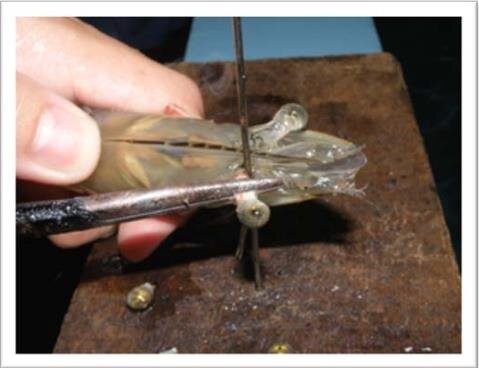
Image credit: Kannan et al. (2015).
Another technique involves making a cut in the eye with a blade or scissors and then crushing the eyestalk between the thumb and index fingernail until the contents of the eye have been removed, as shown in the following image.
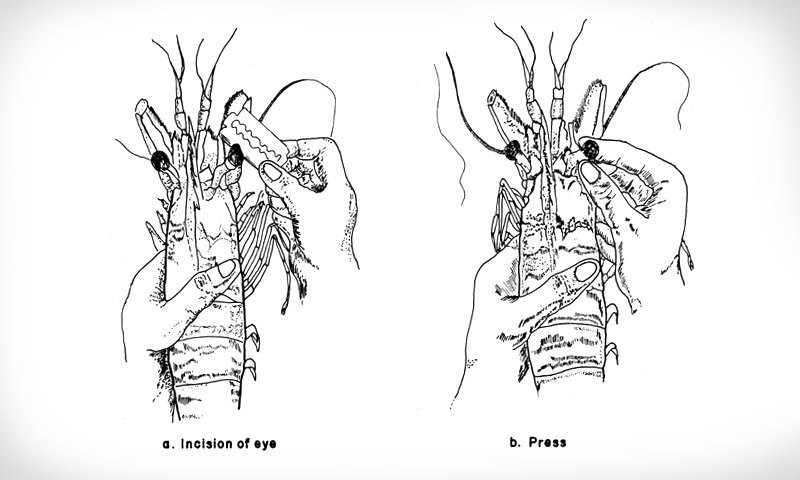
Image credit: Kungvankij et al. (1989 [1986]).
Cauterization is done with an electrocautery device, a hot wire, or forceps44. Ligation, in turn, is done by tying the eyestalk tightly with surgical thread45.
All of these procedures are normally performed without anesthesia46. Studies have shown that shrimp display pain-related behaviors during and after eyestalk ablation, such as tail flicking, rubbing the affected area, and recoiling47. There are also studies showing that such behaviors are reduced after an anesthetic cream is applied to the affected area, which further confirms that the procedure is painful48.
Besides the intense pain and the obvious damage to the eyes and the resulting loss of vision, studies show that the practice impairs their physiological, metabolic, hormonal, and immune systems49, as well as their sensory perception50 and their ability to swim and to move around51. All of this results in higher mortality rates52.
Rowe (2018) cites eyestalk ablation as an example of a practice that would be considered a violation of even the most basic animal welfare standards if it were done to vertebrates, but that is nonetheless routinely practiced on invertebrates53.
Claw removal (declawing)
Declawing (declawing) is the manual amputation of one or both claws of a decapod crustacean. It is most commonly performed on crabs, both farmed and wild-caught. The procedure leaves the animal with impaired feeding and lowers its survival rates54.
Since crabs can naturally shed their own claws in response to stress or danger (which is called autotomy), it is commonly believed that declawing is not painful. This is mistaken, however, since research shows a greater stress response and higher mortality in crabs declawed by humans than in those that underwent autotomy55.
Declawed crabs display behaviors that indicate awareness of the resulting wounds (such as trembling and touching or guarding the wounds with their remaining legs)56. These behaviors are not observed in autotomy, which indicates that the crabs are feeling pain as a result of having their claws removed57.
Returning declawed crabs to the sea
Removing a crab's claws and then returning it to the sea is regarded as a sustainable source of food, since a claw can be torn off for sale and the crab put back into the water, where it is presumed that another claw will grow back58.
However, besides the painful wounds caused by declawing59, the practice also seriously impairs the crab's quality of life after it returns to the sea, since it reduces its ability to feed and to access food sources (which also hinders the regrowth of the claw60), as well as its ability to defend itself against predators61 and to compete for important resources (such as territory, shelter, or mates62). Consequently, the practice also lowers their survival rates63.
Claw nicking
The stressful and cramped conditions in which these animals are kept increase the likelihood of conflict and cannibalism64. Disabling their claws minimizes the risk of harm to other animals and to the workers who handle them. The claw-nicking process (claw nickling) involves fracturing the apodemes65 and cutting the tendons in the dactyls66 of the claws in order to stop them from working. It is performed on animals such as crabs and lobsters, at the time they are being prepared for transport.
The process is extremely harmful to the animals. Since parts of the claw are fractured and cut, they are left with an open wound – besides the pain, the wounds and the damage to internal tissues result in blood loss and an increased risk of infection67. Crabs whose claws had been nicked showed mortality rates of 83%68, whereas crabs that had not been nicked showed a mortality rate of 16.7%69. Moreover,
since the claws are essential to these animals' movement70, the procedure also reduces their ability to feed, to groom themselves, to defend themselves, and even to move71.
Claw banding
Another typical procedure during holding is claw banding (claw banding). The procedure significantly restricts these animals' basic behavior and movements and, if applied over the long term, is associated with muscle atrophy, inhibited feeding, and stress72, besides also reducing the animal's ability to feed, to groom itself, to move, and to defend itself73.
V-notching
Tail notching (also called V-notching, or V-notching) is meant to identify egg-bearing lobsters so that they can be returned to the sea and go on reproducing74. The purpose of the notch is to allow quick and easy identification should they be inadvertently caught again75.
The notch is made by removing a small triangular piece of the tail fan76. Besides the procedure itself being painful, it harms the lobsters through handling, blood loss, risk of infection, and long-term effects such as reduced locomotion and reduced perception of the presence of predators77.
Holding and storage
At some stage of their lives, decapod crustaceans destined for the food industry (whether farmed or caught in the wild) are stored for some period
of time: (1) before, during, or after transport, (2) before being killed, or (3) while on display at points of sale, restaurants, or markets78.
Regardless of its duration (which can reach several months), storage has many negative impacts on the animals because of the risk of poor water quality, inadequate or fluctuating temperatures, restricted behavior, high population density, handling, and mutilations79. Depending on the species and on how long they are stored, they will be kept in water (in tanks with or without recirculation), in air (with varying levels of humidity), or directly on ice80.
Transport
Transport can last several days, subjecting these animals to conditions such as poor water quality, inadequate temperatures, lack of shelter, proximity to other animals, handling, and vehicle vibration and noise81. Besides causing suffering, these factors result in extremely high levels of mortality, whether during transport82 or upon arrival at the destination83.
Being transported out of water and exposed to air, light, and other conditions also seriously harms these animals, since they are aquatic84. Even when they are transported in tanks of water, it is hard to maintain water quality and the correct temperature on long journeys. During transport, the animals at the bottom of the tank are more likely to lose limbs or to be crushed to death by those above them85.
The animals are often starved, since withholding food reduces the amount of waste that builds up during the journey. They are also transported and stored very close to many other animals, sometimes of different species, with very little space. Crustaceans tend to be solitary and territorial, so being close to other animals is
extremely stressful for them. Hunger and dehydration combined with high population densities lead to aggressive behavior and cannibalism86.
Stunning
Stunning is the procedure that would supposedly render the animal completely insensible to pain before it is killed87. At present, electrical stunning is the only method for which research confirms a total loss of central nervous system activity and of responsiveness to sensory stimulation88. Even this method, if it is to stun quickly (within one second), must be carried out with specialized equipment and in accordance with species-specific criteria. However, other methods are used throughout the industry, such as chilling, chemical anesthetics, and CO2 gassing, all of which produce intense agony89.
How they are killed
Decapod crustaceans destined for the food industry are killed in a variety of ways. The most common method is boiling them alive, either by dropping them into boiling water or by gradually raising the water temperature to boiling point90. Live boiling results in severe and prolonged suffering and agony before death, as shown by the animals' vigorous struggling, thrashing, and attempts to escape91.
Other methods include dismemberment, chilling, exposure to high-salt solutions, CO2 gassing, and the use of fresh water to kill animals of marine species, all of which result in intense and prolonged agony92.
Mechanical killing, in turn, whether by "spiking" or by "splitting," carries an extremely high risk of severe suffering because of the precision required, which is hard to
achieve in animals with non-centralized nervous systems93. To avoid pain and agony, all the nerve centers would have to be destroyed simultaneously, which makes mechanical killing incredibly difficult to carry out without causing intense suffering, even for an expert94.
Online sales of decapod crustaceans
Crabs and lobsters are sold online, with the animal delivered alive to the consumer to be stored and killed at home95. The animals may spend hours or days in transit, trapped in boxes, sometimes crammed together in groups, which puts them at risk of injury, suffocation, and death96. Fractures and other fatal injuries are also common, since their bodies are extremely fragile97. Being aquatic animals, they are unable to take in enough oxygen from the air. So if they are denied water, they risk a slow and agonizing death by suffocation before they are even delivered98.
Once delivered, they may be kept, handled, and killed in whatever way the consumer sees fit99. It is extremely difficult to create a storage environment that meets their health and welfare needs, since this involves factors such as the right water quality, temperature, salinity, and light100. Many consumers store crabs and lobsters in the refrigerator or freezer before killing and cooking them, which causes them intense suffering101. Common ways of killing them are chopping them into pieces or boiling them alive while they are fully conscious102. If, as we have seen, it is already extremely difficult for a trained professional to kill them without causing them intense suffering and agony, there is no way an untrained consumer can do so without causing extreme suffering.
1.14. Opposite attitudes, depending on the species of the victims
Despite the immense amount of death and suffering it causes every day, is considered perfectly acceptable by most people. In fact, most people, even without thinking about it, demand that it take place, through their consumption of animal products. Yet if something similar were done to members of the human species, the vast majority of people would consider it not only unjustifiable but also heinous and monstrous. By contrast, the decision whether or not to collaborate with animal exploitation is often seen as a matter of personal preference, of the same kind as choosing what color clothes to wear or what music to listen to, or as something that only animal lovers should care about, rather than as a matter of justice (something that would be widely recognized if the victims were human).
1.15. Can this double standard be justified?
If people hold such disparate attitudes depending on the species to which the victims belong, then they need to explain why it would be right to do such things to nonhuman animals and at the same time wrong to do the same to humans. In fact, many people believe this is so obvious that it needs no explanation. But if that is so, then it should be quite easy to justify this disparity. There is, however, a strong reason to think that it cannot be justified, and the reason is this: whatever explains why it is wrong to do these things to humans automatically implies that it is wrong to do them to any other being capable of suffering and enjoyment. A brief explanation of this follows.
The reason it is unjust to do the same to humans is not that humans belong to the same species we do, or that they possess a range of complex cognitive capacities, a set of relationships with one another, and so on. The reason is much simpler: suffering and dying in those ways seriously harms the victims. However, to be seriously harmed by those situations, one does not need to have complex cognitive capacities or to stand in certain relationships (as the case of babies, for example, attests). Nor does one need to belong to the human species: it is undeniable that the animals subjected to that terrible situation are enormously harmed. To say that their suffering and their deaths do not matter because they do not belong to the human species is analogous to saying that the suffering and deaths of certain humans do not matter because of their race or gender. That is, it would be a case of speciesism. For this reason, there seems to be no way to justify this moral double standard based on the species of the victims. We will look at this in more detail in the next chapter.
Practice
Study layer. The answers are based on the chapter’s text.
Which form of exploitation kills by far the most animals?
According to the chapter, why is it unjust to do to humans what is done to exploited animals?
Food for thought
What do you actually know about how the animal behind some product you used this week lived?
Author’s notes 102
- 1 On evidence of sentience in invertebrates, see Kavaliers et. al. (1983); Lockwood (1988); Smith (1991), (2001); Mather; Anderson (2007), Cabanac et. al. (2009); Carere; Mather (2019) and Ética Animal (2019a, 2021d, 2022b). ↩
- 2 (2018), Sanders (2018). ↩
- 3 (2019). ↩
- 4 Fishcount (2019). ↩
- 5 Fishcount (2019). ↩
- 6 Fishcount (2019). ↩
- 7 Rowe (2021). ↩
- 8 Rowe (2020b). ↩
- 9 Rowe (2020a). ↩
- 10 Waldhorn, Autric (2023). ↩
- 11 A detailed description of how animals are harmed in each form of exploitation can be found in Ética Animal (2016c). ↩
- 12 For a detailed description of the situation of animals exploited for consumption, see (2017a, p. 65-97). Unless otherwise stated, the information described in this chapter has been taken from this work. ↩
- 13 Appleby and Hughes (1991); European Food Safety Authority (2005a). ↩
- 14 Weeks; Butterworth (2004); Bessei (2006). ↩
- 15 Antena3 (2011); Gayle, D. (2013). ↩
- 16 Ética Animal (2016b). ↩
- 17 Id. ↩
- 18 Id. ↩
- 19 Marchant-Forde (2008). ↩
- 20 Van Putten (1982); Le Neindre (1993). ↩
- 21 Eisnitz (1997, p. 92-3). ↩
- 22 L214 (2009, 2010). ↩
- 23 Mitchell (1992); (2003); Averos et. al. (2007). ↩
- 24 Warrick (2001); Pitney (2016). ↩
- 25 Fishcount (2019). ↩
- 26 Cooke and (2007). ↩
- 27 Robb and Kestin (2002). ↩
- 28 Robb and Kestin, Ibid. ↩
- 29 Ética Animal (2021c) ↩
- 30 On these methods, see IPIFF (2019) and Ética Animal (2021c). ↩
- 31 Waldhorn, Autric (2023). ↩
- 32 et al. (2021). On sentience in decapods, see also Crump et al. (2022) and De Souza Valente (2022b). ↩
- 33 Crustacean Compassion (2023). ↩
- 34 Basti et al. (2010). ↩
- 35 Basti et al. (2010). ↩
- 36 Crustacean Compassion. (2024a). ↩
- 37 Id. ↩
- 38 Crustacean Compassion. (2024a). ↩
- 39 Crustacean Compassion. (2024b). ↩
- 40 Id. ↩
- 41 Wright (2019). ↩
- 42 Uawisetwathana et al. (2011). ↩
- 43 On all these procedures, see Asmat-Ullah (2023). ↩
- 44 Id. ↩
- 45 Id. ↩
- 46 Animals Australia (2017); Marshall; Cronin (2011). ↩
- 47 Diarte-Plata et al. (2012); Taylor et al. (2004). ↩
- 48 Taylor et al. (2004); Diarte-Plata et al. (2012). ↩
- 49 Bae et al. (2013); Sainz-Hernandez et al. (2008); Perazzolo et al. (2002); Kramer (2020). ↩
- 50 Bae et al. (2013); Sainz-Hernandez et al. (2008); Perazzolo et al. (2002). ↩
- 51 Taylor et al. (2004). ↩
- 52 Bae et al. (2013); Sainz-Hernandez et al. (2008). ↩
- 53 Rowe (2018). There are already initiatives under way to phase out eyestalk ablation and to use other methods of increasing female fertility, such as raising the female-to-male sex ratio in the tank and providing nutritious, high-quality feed in the pre-maturation phase. On this, see Wright (2019); Zacarias et al. (2019); Kramer (2020); The Fish Site (2020). ↩
- 54 Crustacean Compassion (2024b). ↩
- 55 Patterson et al. (2007); Patterson et al. (2009). ↩
- 56 McCambridge et al. (2016). ↩
- 57 Id. ↩
- 58 Crustacean Compassion (2024b). ↩
- 59 Duermit et al. (2015). ↩
- 60 Patterson et al. (2009); Duermit et al. (2015). ↩
- 61 Davis et al. (1978). ↩
- 62 Davis et al. (1978). ↩
- 63 Patterson et al. (2007); Duermit et al. (2015). ↩
- 64 Fotedar; Evans (2011); Jacklin; Combes (2007); Coppola et al. (2019); Welsh et al. (2013). ↩
- 65 Apodeme is the name given to the internal processes of the exoskeleton of most arthropods. See Contribuidores da Wikipédia (2019). ↩
- 66 The dactyl is the tip region of the leg in some crustaceans and of the tentacle in cephalopods. See Wikipédia Contributors (2024). ↩
- 67 Welsh et al. (2013); Barrento et al. (2010). ↩
- 68 Barrento et al. (2008); Johnson et al. (2016); Chartois et al. (1994). ↩
- 69 Johnson et al. (2016). ↩
- 70 Carder (2017); Esposito et al. (2018). ↩
- 71 Crustacean Compassion. (2024b). ↩
- 72 Id. ↩
- 73 Id. ↩
- 74 Id. ↩
- 75 Id. ↩
- 76 Id.. ↩
- 77 Id. ↩
- 78 Crustacean Compassion. (2024a). ↩
- 79 Crustacean Compassion (2023). ↩
- 80 Crustacean Compassion. (2024a). ↩
- 81 Crustacean Compassion (2023). ↩
- 82 Barrento et al. (2010, 2012). Lu et al. (2015). ↩
- 83 Barrento et al. (2008, 2010); Uglow et al. (1986). ↩
- 84 Crustacean Compassion. (2024a). ↩
- 85 Id. ↩
- 86 Id. ↩
- 87 Crustacean Compassion. (2024c). ↩
- 88 Roth; Øines (2010); Roth; Grimsbø (2016); Fregin; Bickmeyer (2016); Weineck et al. (2018). ↩
- 89 Crustacean Compassion. (2024c). ↩
- 90 Crustacean Compassion. (2024d). ↩
- 91 Conte et al. (2021); Adams et al. (2019). ↩
- 92 Crustacean Compassion. (2024d). ↩
- 93 Id. ↩
- 94 Id. ↩
- 95 Crustacean Compassion. (2024e). ↩
- 96 Id. ↩
- 97 Id. ↩
- 98 Id. ↩
- 99 Id. ↩
- 100 Id. ↩
- 101 Id. ↩
- 102 Id. ↩
Sources cited in this text 87
The full list for the volume is in the Volume IV references.
- ADAMS, R., STANLEY, C.E., PIANA, E., & COOPER, R.L. Physiological and Behavioural Indicators to Measure Crustacean Welfare. Animals (Basel), v. 9. n. 11, p. 914, 2019.
- ANIMALS AUSTRALIA. The shocking practice that shows prawn farming is as cruel as factory farming". Animals Australia: For a Kinder World. 28 ago. 2017.
- APPLEBY, M. C.; HUGHES, B. O. Welfare of laying hens in cages and alternative systems: Environmental, physical and behavioral aspects. World’s Poultry Science Journal, v. 47, p. 109-128, 1991.
- ASMAT-ULLAH, M.; ROZAIMI, R.; FAZHAN, H.; SHU-CHIEN, A. C.; WANG, Y.; WAIHO, K. Eyestalk Ablation to Increase Ovarian Maturation in Mud Crabs. J. Vis. Exp, v. 193, e65039, 2023.
- AVEROS, X.; HERRANZ, A.; SANCHEZ, R.; COMELLA, J. X. AND GOSALVEZ, L. F. Serum stress parameters in pigs transported to slaughter under commercial conditions in different seasons. Veterinarni Medicina, v. 52, p. 333-342, 2007.
- BAE, S-H., TOMOYUKI, O., BONG, J.K., AND WILDER, M.N. Alterations of pattern in immune response and vitellogenesis during induced ovarian development by unilateral and bilateral ablation in Litopenaeus vannamei. Fish Science, v. 79, p. 895–903, 2013.
- BARRENTO, S., MARQUES, A., PEDRO, S., VAZ-PIRES, P., AND NUNES, M.L. The trade of live crustaceans in Portugal: space for technological improvements. ICES Journal of Marine Science, v. 65. n.4, p. 551-559, 2008.
- BARRENTO, S., MARQUES, A., VAZ-PIRES, P. & NUNES, M.L. Physiological Changes during Simulated Live Transport of Cancer Pagurus and Recovery in Holding Tanks. Aquaculture Research, v. 43, p. 1415-1426, 2012.
- BARRENTO, S., MARQUES, A., VAZ-PIRES, P., AND NUNES, M.L. Live shipment of immersed crabs Cancer pagurus from England to Portugal and recovery in stocking tanks: stress parameter characterization. ICES Journal of Marine Science, v. 67, n. 3, p. 435-443, 2010.
- BASTI, D., BRICKNELL, I., HOYT, K., CHANGE, E.S., HALTEMAN, W., & BOUCHARD, D. Factors Affecting Post-Capture Survivability of Lobster Homarus Americanus. Dis Aquat Organ, v. 90, n. 2, p. 153-66, 2010.
- BESSEI, W. Welfare of broilers: A review. World’s Poultry Science Journal, v. 62, p. 455- 466, 2006.
- BIRCH, J.; BURN, C.; SCHNELL, A.; BROWNING, H; CRUMP, A. Review of the Evidence of Sentience in Cephalopod Molluscs and Decapod Crustaceans. London: The London School of Economics and Political Science 2021.
- BROOM, D. M. Transport stress in cattle and sheep with details of physiological, ethological and other indicators. Deutsche Tierarztliche Wochenschrift, v. 110, p. 83-89, 2003.
- CABANAC, M.; CABANAC, A. J.; PARENT, A. The emergence of consciousness in phylogeny. Behavioural Brain Research, v. 198, p. 267-272, 2009.
- CARDER, G. A preliminary investigation into the welfare of lobsters in the UK. Animal Sentience: An Interdisciplinary Journal on Animal Feeling, v. 2. n. 16, p. 19, 2017.
- CARERE, C.; MATHER, J. (orgs.). The welfare of invertebrate animals, Dordrecht: Springer, 2019.
- CHARTOIS, H., LATROUITE, D., AND LE CARRE, P. Stocking and transportation of live crustaceans. Report of the Directorate of Live Resources. IFREMER, Brest, France, 65pp., 1994.
- CONTE, F., VOSLAROVA, E., VECEREK, V., ELWOOD, R.W., COLUCCIO, P., PUGLIESE, M., & PASSANTINO, A. Humane Slaughter of Edible Decapod Crustaceans. Animals (Basel), v. 11, n. 4, p. 1089, 2021.
- CONTRIBUIDORES DA WIKIPÉDIA. Apódema. Wikipédia: a enciclopédia livre, 17 jul. 2019.
- COOKE, S. J.; SNEDDON, L. U. Animal welfare perspectives on recreational angling. Applied Animal Behaviour Science, v. 104, p. 176-198, 2007.
- COPPOLA, C., TIRLONI, E., VASCONI, M., ANASTASIO, A., STELLA, S., AND BERNARDI, C. The effects of claw ligatures in American lobster (Homarus americanus) storage: a preliminary study of haemolymph parameters. Acta Veterinaria Brno, v. 88, n. 3, p. 329-335, 2019.
- CRUMP, A.; BROWNING, H.; SCHNELL, A.; BURN, C.; BIRCH, J. Sentience in decapod crustaceans: A general framework and review of the evidence. Animal Sentience, v. 7. n. 32, 2022.
- CRUSTACEAN COMPASSION Capture, Transport & Storage. Crustacean compassion, 2024a. Disponível em: https://www.crustaceancompassion.org/capture-transport-storage. Acesso em: 07 dez. 2024
- CRUSTACEAN COMPASSION. Mutilations: Eyestalk Ablation, Declawing & Claw Nicking. Crustacean compassion, 2024b. Disponível em: https://www.crustacean compassion.org/m. Acesso em: 07 dez. 2024
- CRUSTACEAN COMPASSION. Online sales of Decapod Crustaceans. Crustacean compassion, 2024e. Disponível em: https://www.crustaceancompassion.org/live-sales. Acesso em: 07 dez. 2024
- CRUSTACEAN COMPASSION. Sea-to-Plate: The Welfare Journey of Decapod Crustaceans, 2023.
- CRUSTACEAN COMPASSION. Slaughter. Crustacean compassion, 2024d. Disponível em: https://www.crustaceancompassion.org/slaughter. Acesso em: 07 dez. 2024.
- CRUSTACEAN COMPASSION. Stunning. Crustacean compassion, 2024c. Disponível em: https://www.crustaceancompassion.org/stunning. Acesso em: 07 dez. 2024
- DAVIS, G.E., BAUGHMAN, D.S., CHAPMAN, J.D., MACARTHUR, D., AND PIERCE, A.C. Mortality associated with declawing stone crabs, Menippe mercenaria. South Florida Research Center. National Park Service, Report T-552. 20pp, 1978.
- DE SOUZA VALENTE, C. Decapod sentience: Broadening the framework. Animal Sentience, v. 32, n. 8, 2022b.
- DIARTE-PLATA, G.; SAINZ-HERNÁNDEZ, J.C.; AGUIÑAGA-CRUZ, J.A.; FIERRO- CORONADO, J.A.; POLANCO-TORRES, A; PUENTE-PALAZUELOS, C. Eyestalk ablation procedures to minimize pain in the freshwater prawn Macrobrachium americanum. Applied Animal Behaviour Science, v. 140, n. 3, p. 172–178, 2012.
- DUERMIT, E., KINGSLEY-SMITH, P.R., AND WILBER, D.H. The Consequences of Claw Removal on Stone Crabs Menippe spp. and the Ecological and Fishery Implications. North American Journal of Fisheries Management, v. 35, p. 895–905, 2015.
- EISNITZ, G. Slaughterhouse: The Shocking Story of Greed, Neglect, and Inhumane Treatment Inside the U.S. Meat Industry. Amherst: Prometheus Books, 1997.
- ESPOSITO, G., NUCERA, D., AND MELONI, D. Retail Stores Policies for Marketing of Lobsters in Sardinia (Italy) as Influenced by Different Practices Related to Animal Welfare and Product Quality. Foods, v. 7. n. 7, p. 103. Chicago, 2018.
- FISHCOUNT. Fishcount estimates of numbers of individuals killed in (FAO) reported fishery production. Fishcount: Reducing suffering in fisheries, 2019.
- FOTEDAR, S., AND EVANS, L. Health management during handling and live transport of crustaceans: a review. Journal of invertebrate pathology, v. 106, n. 1, p. 143-152. 2011.
- FREGIN, T., & BICKMEYER, U. Electrophysiological Investigation of Different Methods of Anesthesia in Lobster and Crayfish. PLoS One, v. 11, n. 9, p. e0162894, 2016.
- HORTA, O. Un paso adelante en defensa de los animales. Madrid: Plaz y Valdés, 2017a.
- IPIFF - INTERNATIONAL PLATFORM OF INSECTS FOR FOOD AND FEED. Guide on good hygiene practices for European Union (EU) producers of insects as food and feed, [s.l.], p. 36-39, 2019.
- JACKLIN, M., AND COMBES, J. The good practice guide to handling and storing live Crustacea. Sea Fish Industry Authority Publication, 2007.
- JOHNSON, L., COATES, C.J., ALBALAT, A., TODD, K., AND NEIL, D. Temperature-dependent morbidity of ‘nicked’ edible crab, Cancer pagurus. Fisheries Research, v. 175, p. 127-131, 2016.
- KANNAN, D.; THIRUNAVUKKARASU, P.; JAGADEESAN, K.; SHETTU, N; KUMAR, A. Procedure for maturation and spawning of imported shrimp Litopenaeus vannamei in commercial hatchery, south east coast of India. Fisheries and Aquaculture Journal, v. 6, n. 4, p. 1-5, 2015.
- KAVALIERS, M.; HIRST, M.; TESKY, G. C. A functional role for an opiate system in snail thermal behaviour. Science, v. 220, p. 99-101, 1983.
- KRAMER, L. Researcher Simao Zacarias proves eyestalk ablation is unnecessary and increases vulnerability to disease. Global Seafood Alliance, 21 set. 2020.
- KUNGVANKIJ, P., TIRO, L. B. J., PUDADERA, B. J. J., POTESTAS, I. O., CORRE, K. G., BORLONGAN, E.; CHUA, T. E.. Shrimp hatchery design, operation and management. Bangkok, Thailand: Network of Aquaculture Centres in Asia, Aquaculture extension manual, n.14; NACA training manual series, n. 1, 1989 [1986].
- LE NEINDRE, P. Evaluating housing systems for veal calves. Journal of Animal Science, n. 71, p. 1345-1354, 1993.
- LOCKWOOD, J. A. Not to Harm a Fly: Our Ethical Obligations to Insects. Between the Species: n. 3, v.4, 1988, p. 204-211.
- LU, Y., WANG, F., & DONG. S. Energy Response of Swimming Crab Portunus Trituberculatus to Thermal Varation: Implication for Crab Transport Method. Aquacultura, v. 441, p. 64-71, 2015.
- MARCHANT-FORDE, J. N. (org.) The welfare of pigs. Dordrecht: Springer, 2008.
- MATHER, J. A. Animal suffering: An invertebrate perspective. Journal of Applied Animal Welfare Science, v. 4, p. 151-156, 2001.
- MATHER, J. A.; ANDERSON, R. C. Ethics and invertebrates: A cephalopod perspective. Diseases of Aquatic Organisms, v. 75, p. 119-129, 2007.
- MCCAMBRIDGE, C., DICK, J.T.A, AND ELWOOD, R.W. Effects of autotomy compared to manual declawing on contests between males for females in the edible crab Cancer pagurus: implications for fishery practice and animal welfare. Journal of Shellfish Research v. 35, n. 4, p. 1037-1044, 2016.
- MITCHELL, M. Indicators of physiological stress in broiler chickens during road transportation. Animal Welfare, v. 1, p. 91-103, 1992.
- OUR WORLD IN DATA. Number of animals slaughtered for meat, World, 1961 to 2018. Our world in data, [s.l.], 2018.
- PATTERSON, L., DICK, J.T.A., AND ELWOOD, R.W. Claw removal and feeding ability in the edible crab, Cancer pagurus: Implications for fishery practice. Applied Animal Behaviour Science v. 116, n. 302-305, 2009.
- PATTERSON, L., DICK, J.T.A., AND ELWOOD, R.W. Physiological stress responses in the edible crab, Cancer pagurus, to the fishery practice of de-clawing. Marine Biology v. 152, p. 265-272, 2007.
- PERAZZOLO, L.M., GARGIONI, R., OGLIARI, P., MARGHERITA A.A., AND BARRACCO, M.A.A. (2002). Evaluation of some hemato-immunological parameters in the shrimp Farfantepenaeus paulensis submitted to environmental and physiological stress. Aquaculture, v. 214, p. 19–33
- PITNEY, N. Scientists believe the chickens we eat are being slaughtered while conscious. The Huffington Post, 28 out. 2016.
- ROBB, D. H. F.; KESTIN, S. C. Methods used to kill fish: Field observations and literature reviewed. Animal Welfare, v. 11, p. 269-282, 2002.
- ROTH, B., & GRIMSBØ, E. Electrical Stunning of Edible Crabs (Cancer Pagurus): From Single Experiments to Commercial Practice. Animal Welfare, v. 25, n. 4, p. 489-497, 2016.
- ROTH, B., & ØINES, S. Stunning and Killing of Edible Crabs (Cancer Pagurus). Animal Welfare, v. 19, n. 3, p. 287-294, 2010.
- ROWE, A. Global cochineal production: scale, welfare concerns, and potential interventions. Effective altruism forum, 11 fev. 2020a.
- ROWE, A. Insects raised for food and feed — global scale, practices, and policy. Rethink priorities, 29 jun. 2020b.
- ROWE, A. Should scientific research involving decapod crustaceans require ethical review? Journal of Agricultural and Environmental Ethics, v. 31, n. 5, p. 625-634, 2018.
- ROWE, A. Silk production: global scale and animal welfare issues. Rethink priorities, 19 abr. 2021.
- SAINZ-HERNANDEZ, J.C., RACOTTA, I.S., SILVIE, D., HERNANDEZ-LOPEZ. J. Effect of unilateral and bilateral eyestalk ablation in Litopenaeus vannamei male and female on several metabolic and immunologic variables. Aquaculture, v. 283, n. 1-4, p. 188-193, 2008.
- SANDERS, B. Global Animal Slaughter Statistics And Charts. Faunalytics, 10 out. 2018.
- SMITH, J. A. A question of pain in invertebrates. ILAR Journal, v. 33, p. 25-31, 1991.
- TAYLOR, J., VINATEA, L., OZORIO, R., SCHUWEITZER, R., AND ANDREATTA, E.R. Minimizing the effects of stress during eyestalk ablation of Litopenaeus vannamei females with topical anesthetic and a coagulating agent. Aquaculture, v. 233, n. 1-4), p. 173-179, 2004.
- THE FISH SITE. The case against eyestalk ablation in shrimp aquaculture. The Fish Site: Aquaculture for All, 22 set. 2020.
- UAWISETWATHANA U.; LEELATANAWIT R.; KLANCHUI A.; PROMMOON J.; KLINBUNGA S.; KAROONUTHAISIRI N. Insights into eyestalk ablation mechanism to induce ovarian maturation in the black tiger shrimp. PLoS One, v. 6, n. 9, e24427, 2011.
- UGLOW, R.F., HOSIE, D.A., JOHNSON, I.T., & MACMULLEN, P.H. Live handling and transport of crustacean shellfish: An investigation or mortalities. Seafish Technology SR280 MAFF R&D Commission 1985/86, 1986.
- VAN PUTTEN, G. Welfare in veal calf units. Veterinary Record, v. 111, p. 437-440, 1982.
- WALDHORN, D. AUTRIC, E. Shrimp: The animals most commonly used and killed for food production. Rethink Priorities, 11 ago. 2023.
- WARRICK, J. They die piece by piece. Washington Post, 10 abr. 2001.
- WEEKS, C. A.; BUTTERWORTH, A. Measuring and auditing broiler welfare. Wallingford: CABI, 2004.
- WEINECK, K., RAY, A.J., FLECKENSTEIN, L.J., MEDLEY, M., DZUBUK, N., PIANA, E., & COOPER, R.L. Physiological Changes as a Measure of Crustacean Welfare under Different Standardized Stunning Techniques: Cooling and Electroshock. Animals (Basel), v. 8, n. 9, p. 158, 2018.
- WELSH, J. E., KING, P. A., AND MACCARTHY, E. (2013). Pathological and physiological effects of nicking on brown crab (Cancer pagurus) in the Irish crustacean fishery. Journal of invertebrate pathology, v. 112, n. 1, p. 49-56, 2013.
- WIKIPEDIA CONTRIBUTORS. Dactylus. Wikipedia: The Free Encyclopedia, 21 mai. 2024.
- WRIGHT, J. Stirling researchers identify viable ablation alternatives for shrimp hatcheries. Global Aquaculture Alliance, 29 jan. 2019.
- ZACARIAS, S., CARBONI, S., DAVIE, A., AND LITTLE, D.C.Reproductive performance and offspring quality of non-ablated Pacific white shrimp (Litopenaeus vannamei) under intensive commercial scale conditions. Aquaculture, v. 503, p. 460-466, 2019.
- ÉTICA ANIMAL. Animais usados por humanos. Ética Animal: ativismo e investigação em defesa dos animais, 26 abr. 2016c.
- ÉTICA ANIMAL. Doenças que afetam os animais aquáticos explorados. Ética Animal: ativismo e investigação em defesa dos animais, 28 out. 2016b.
- ÉTICA ANIMAL. O uso de insetos para alimentação. Ética Animal: ativismo e investigação em defesa dos animais, 21 out. 2021c.
- ÉTICA ANIMAL. Senciência em invertebrados: uma revisão da literatura neurocientífica. Ética Animal: ativismo e investigação em defesa dos animais, 20 ago. 2019a.
- ÉTICA ANIMAL. Senciência em invertebrados: uma revisão das evidências comportamentais. Ética Animal: ativismo e investigação em defesa dos animais, 20 jul. 2022b.
- ÉTICA ANIMAL. Uma fisiologia ilustrada do sistema nervoso de invertebrados. Ética Animal: ativismo e investigação em defesa dos animais, 3 set. 2021d.
Recommended texts
Keep exploring The Debate on Animal Exploitation.
Why Is Animal Exploitation Unjust?
Animal exploitation is unjust because it violates the principle of equal consideration and fails the…
What Is Veganism?
Veganism is the position of avoiding harm to animals out of respect for them, refusing the products and…
What About Plants?
The plant objection fails: plants are alive, but without a centralized nervous system there's no evidence…